
Worked example · Fictional firm · IFR
Worked example: one IFR reporting period for a fictional Class 2 firm
Contoso Investments is the fictional firm in the Everix Cloud IFR guided demo. This page walks through one quarter with its synthetic data, from the first upload to the review and export, so you can see what the service does before you bring your own.
Last reviewed
Fictional firm, synthetic data
Contoso Investments does not exist and is not an Everix client. Its data was made up to show the workflow. You can open the same firm in the guided demo: it is read-only and needs no account.At a glance
- Firm: a French portfolio manager that also gives investment advice. It holds no client money and has no trading book.
- Period: the quarter ending 30 September 2026, in euros.
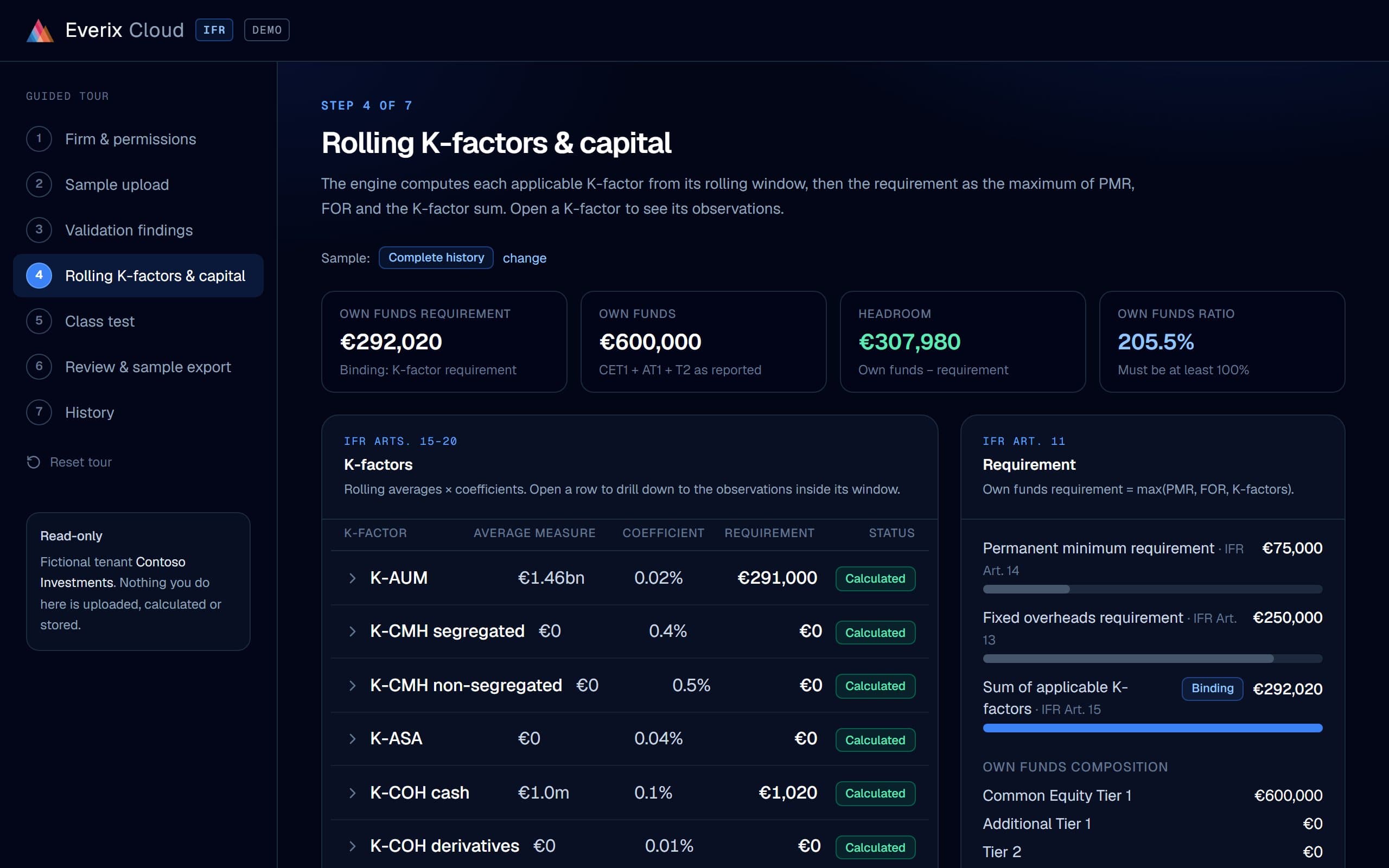
- Outcome: own funds requirement of €292,020, set by the K-factors; own funds of €600,000, a ratio of 205.5%.
- Product: Everix Cloud IFR. Nothing to install.
The period, step by step
- Firm and people. The firm is its own tenant, with one person per role: preparer, reviewer, officer and viewer.
- Upload. The preparer fills in versioned CSV templates for activity history and financials. Files go to quarantine first.
- Validation. Every observation is checked before anything is calculated. Blocking findings stop the run; the others are listed for review.
- K-factors and capital. Each applicable K-factor is computed over its rolling window. The requirement is the highest of the permanent minimum, the fixed overheads requirement and the sum of K-factors.
- Class test. Average assets under management of about €1.46 billion are above the €1.2 billion limit in IFR Article 12(1)(a), so the firm cannot be Class 3 and reports as Class 2.
- Review and export. The reviewer and the officer approve the run, and the EBA templates are generated for the pack.
- History. Each run is kept with its inputs, its state and who did what and when.
The capital calculation
Euros, rounded to the euro as on the demo screen. K-factors that do not apply to this firm (client money, assets safeguarded, trading flow, market risk, counterparty and concentration risk) are zero.
| Line | Rule | Amount (EUR) |
|---|---|---|
| K-AUM | Average assets under management × 0.02% (IFR Art. 17) | 291,000 |
| K-COH (cash) | Average client orders handled × 0.1% (IFR Art. 20) | 1,020 |
| Other K-factors | Not applicable to this firm | 0 |
| Sum of K-factors | IFR Art. 15 | 292,020 |
| Permanent minimum requirement | IFR Art. 14 | 75,000 |
| Fixed overheads requirement | A quarter of €1,000,000 fixed overheads (IFR Art. 13) | 250,000 |
| Own funds requirement | The highest of the three (IFR Art. 11): the K-factors | 292,020 |
| Own funds | Common Equity Tier 1; no AT1 or Tier 2 | 600,000 |
| Headroom | Own funds − requirement | 307,980 |
| Own funds ratio | Own funds ÷ requirement; must be at least 100% | 205.5% |
Synthetic data from the Everix Cloud IFR guided demo.
K-AUM
- Rule
- Average assets under management × 0.02% (IFR Art. 17)
- Amount (EUR)
- 291,000
K-COH (cash)
- Rule
- Average client orders handled × 0.1% (IFR Art. 20)
- Amount (EUR)
- 1,020
Other K-factors
- Rule
- Not applicable to this firm
- Amount (EUR)
- 0
Sum of K-factors
- Rule
- IFR Art. 15
- Amount (EUR)
- 292,020
Permanent minimum requirement
- Rule
- IFR Art. 14
- Amount (EUR)
- 75,000
Fixed overheads requirement
- Rule
- A quarter of €1,000,000 fixed overheads (IFR Art. 13)
- Amount (EUR)
- 250,000
Own funds requirement
- Rule
- The highest of the three (IFR Art. 11): the K-factors
- Amount (EUR)
- 292,020
Own funds
- Rule
- Common Equity Tier 1; no AT1 or Tier 2
- Amount (EUR)
- 600,000
Headroom
- Rule
- Own funds − requirement
- Amount (EUR)
- 307,980
Own funds ratio
- Rule
- Own funds ÷ requirement; must be at least 100%
- Amount (EUR)
- 205.5%
Everix Cloud IFR · guided demo · capital
What the example shows
- Each figure traces back to its rule and its observations: open a K-factor in the demo to see the months inside its window.
- The binding constraint is named, so the officer sees at once that K-AUM, not fixed overheads, sets the requirement.
- The pack is checked before you file: Arelle, the EBA filing rules and the EBA validation rules, as described on the IFR solution page.
- Your firm reviews, approves and files the return. Everix prepares and checks it.
Related on everix.io